

Before you dig
- Call Arizona 811 to have underground utilities marked — it’s free and required before digging.
- Check with your city and HOA whether the structure needs a permit or approval (see our permits guide).
- Confirm your sail size against your post layout, leaving room for hardware.
Set the posts
Posts do the real work. Use steel posts sized for your sail, set in concrete footings sized for your soil and load — not a generic hole depth. Rake each post a few degrees away from the sail so tension pulls it toward vertical rather than past it. Let concrete cure fully before tensioning.
Attach to the house (if using it)
Fasten pad eyes or brackets into structural framing, a beam or masonry with anchors rated for the load. Never anchor to stucco alone, fascia trim or gutters. If the house can’t take the load, add a post.
Hang the sail
- Lay the sail out under its final position and orient the corners to their anchors.
- Attach hardware to each corner D-ring with the tensioner fully extended (turnbuckle opened out, pulley line slack).
- Clip every corner to its anchor loosely before tensioning any of them.
Tension evenly
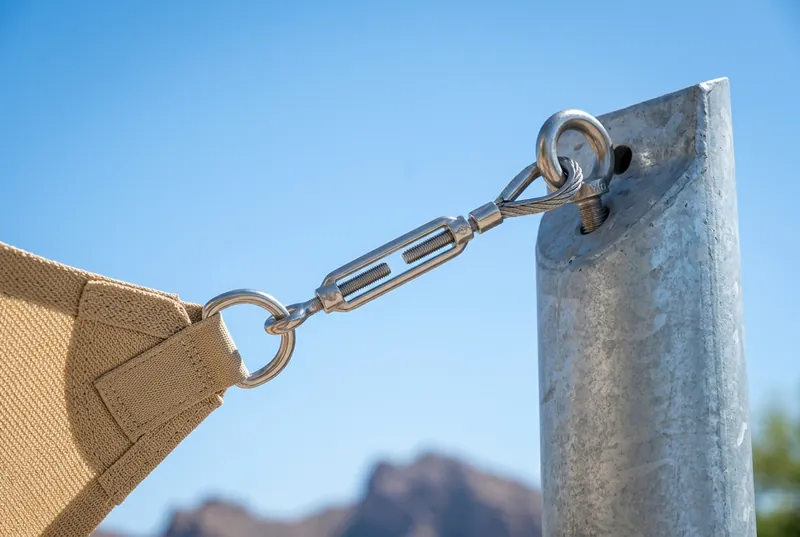
Tighten a little at each corner in turn, working around the sail, so it pulls evenly into shape. Stop when the fabric is taut with no wrinkles or flapping edges — drum-tight but not so tight the posts deflect. Tension will settle over the first days; re-check and take up slack.
Three tensioning methods: a turnbuckle (simple, small sails), a 4:1 pulley kit (large sails, fast take-down), or a winch system on engineered structures. Compare hardware.
Care and take-down
- Rinse with a hose and mild soap; avoid pressure washers and harsh chemicals.
- Re-tension after the first week and a few times a year.
- Take residential sails down before severe monsoon storms if they aren’t on an engineered structure — snap hooks or pulleys make this quick.
- Keep heat sources (grills, fire pits) well clear of the fabric.